
Executive Summary: Home loan refinancing replaces your existing mortgage (bond) with a new one on the same property, often at a lower interest rate or different term. In the current South African context, falling interest rates have made refinancing attractive: SARB has cut its repo rate from 8.25% (mid-2024) down to 6.75% (late 2025), which brought the prime lending rate from about 11.75% toward ~10.25%. Homeowners can tap these lower rates to cut monthly bond payments. Refinancing can also unlock home equity for renovations or debt consolidation. This guide explains what refinancing is, when and why to do it in SA, the step-by-step process (with a flowchart), key factors (rates, term, fees), and an illustrative numeric example of savings. We also address FAQs and provide a Check Current Home Loan Rates CTA for a live quote.
What is Mortgage Refinancing?
Mortgage refinancing means taking out a new home loan secured by your property to replace the old one. Practically, you “apply for a new bond on your home based on its current value rather than the value it had when you first bought the home”. In effect, the bank cancels (“crosses out”) your existing bond and registers a new bond (often for the same outstanding balance or more) on the title deed. As Ooba explains, refinancing lets you refinance “like applying for a second bond” – you undergo a full credit assessment and the home is revalued. If approved, the new lender pays out the loan and the old bond is cancelled. Many homeowners refinance to reduce their interest rate (lowering monthly instalments) or to access equity (the difference between what they owe and the home’s current value).

When & Why to Refinance in SA?
Refinancing makes sense when interest rates fall or when you need cash from your home’s equity. In 2024–2025 South Africa saw significant rate cuts: the SARB’s repo rate dropped from 8.25% in early 2024 to 6.75% by Nov 2025. Consequently, the prime lending rate fell from about 11.75% (mid-2024) to ~10.25% by early 2026. This has created an opportunity: Ooba notes that homeowners looking to reduce monthly expenses or consolidate debt can refinance at lower rates, “saving money in the short term”. For example, Moneyweb reported prime at 11.75% in May 2024, but by Jan 2026 prime was down to 10.25%. If your original bond rate is significantly above current rates, you could lock in lower repayments by switching. You might also refinance if your credit profile has improved, or to extend the term for lower instalments (at the cost of more total interest).

Interest Rate Trend (2024–2026): Over 2024–2025 SARB cut rates for the first time since 2023, and in May 2026 implemented a small hike. For example, after holding the repo at 6.75%, the Bank raised it 25 bps to 7.00% on May 28, 2026. These moves have kept mortgage rates near historic highs, but lower than earlier peaks. (Chart: South African repo rate timeline 2024–2026.)
Figure 1. South African repo rate (%) 2024–2026 (source: SARB and news releases).
When to refinance? A key trigger is a rate drop. As shown above, the prime rate moved from ~11.75% to ~10.25%, so any homeowner with a bond above those levels should consider refinancing. Ooba observes that “more people are looking at ways to reduce their monthly expenses” through refinancing. Reasons include: lowering the interest rate, accessing equity for renovation or debt repayment, consolidating other loans into the mortgage, or switching banks for better service or a longer term. It’s typically worth refinancing if the interest savings (times the remaining term) exceed the transaction costs.
Step-by-Step Refinancing Process
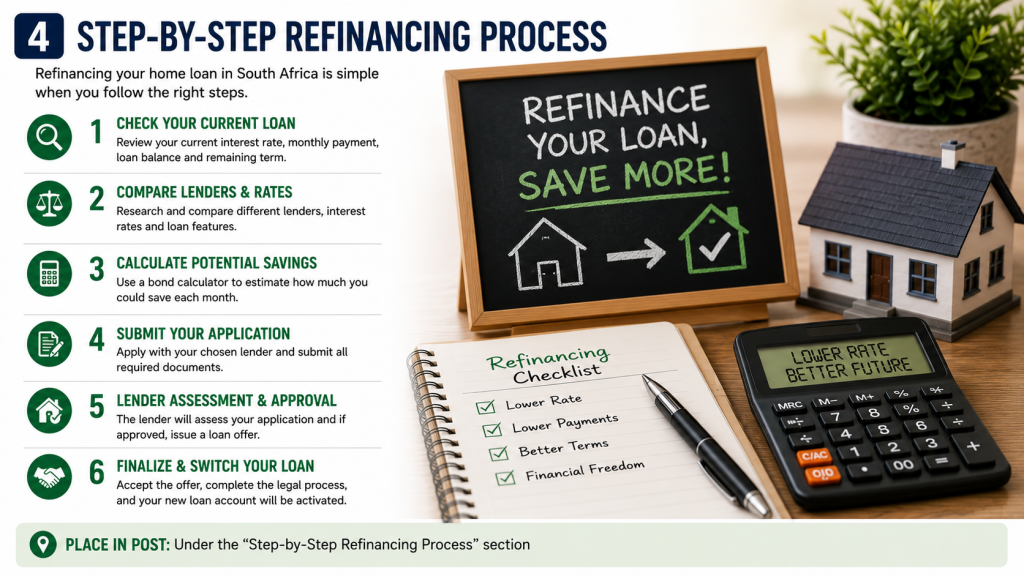
Refinancing follows much the same steps as applying for a home loan. In summary: assess your current loan, shop for better rates, apply for a new loan, then cancel the old bond and register the new one. Below is a simplified flowchart of the refinance process:
flowchart LR
    A[Assess need to refinance] --> B[Review current bond (rate, term, penalties)]
    B --> C{Is refinance beneficial?}
    C -->|No| Z[Stay with existing loan]
    C -->|Yes| D[Gather documents (income, statements, credit record)]
    D --> E[Compare lenders & new rates/fees]
    E --> F[Submit refinance application]
    F --> G[Credit assessment & property valuation]
    G --> H{Loan approved?}
    H -->|No| I[Try other lender or improve profile]
    H -->|Yes| J[Arrange cancellation of old bond (attorney process)]
    J --> K[Register new bond and receive funds]
K --> L[Begin new repayments at lower rate]- Assess & Prepare: Check your existing loan’s interest rate, remaining term, and any early-termination penalties. Gather required documents (ID, payslips, bank statements, proof of residence, etc.). Review your bond contract for any lock-in clauses or break costs (often up to 3 months’ interest).
- Compare Offers: Use bank websites or brokers to compare variable vs. fixed rates and fees. Consider pre-approval or rate quotes from several banks – as Ooba notes, applying to multiple banks can help secure the best deal.
- Apply: Submit a full application (similar to a new home loan). The lender will do a credit check and a home valuation. According to Ooba, “you apply the same way you would for a bond” – the home is revalued and your credit record is assessed.
- Approval & Settlement: If approved, the new lender organizes cancellation of the old bond (paying out the old bank) and registers the new bond. You’ll repay any existing debt from the new loan. In some cases you can withdraw extra cash if you have equity (see FAQ below). The process typically takes 4–8 weeks (attorney and Deeds Office registration can vary by province).
Note: Most lenders will require a fresh credit check and affordability assessment, even though you’ve repaid an existing bond. They must ensure you can afford the new repayments under the National Credit Act.
Key Factors: Rates, Term, and Costs
Several factors affect whether refinancing makes sense and how much you save:

- Interest Rate: The primary driver is the difference between your old rate and the new rate. Each 0.25% (25 basis points) cut on a large bond can shave a significant amount off your monthly instalment. For example, Ooba shows that reducing the rate from 11.75% to 10.25% on a R2 million loan cuts the payment by R1,644 per month. In general, variable home loan rates in SA are set as prime + a margin based on your profile. By Jan 2026, prime was 10.25%. Banks like Absa, FNB, Nedbank and Standard typically price home loans in a range around prime; well-qualified borrowers might get rates at or just below prime, while others pay slightly above.
- Loan Term: Refinancing lets you extend or shorten the amortization. Extending the term (e.g. from 20 to 30 years) reduces monthly repayments but increases total interest paid. Shortening the term raises the monthly payment but cuts total interest. Choose a term that balances monthly affordability with interest cost.
- Transaction Costs: Refinancing incurs fees that you must offset with interest savings. Major costs include initiation/processing fees, bond cancellation and registration costs, valuation fees, and possibly penalties. All major banks charge roughly the same initiation fee (≈R6,000). Monthly account fees (~R69), plus attorneys’ fees for cancelling the old bond and registering the new one, apply. Early termination charges are common: Nedbank, Standard and Absa typically levy up to 90 days’ interest as a penalty if you cancel early. (FNB notably waived early-exit fees in 2022, but this is not always the case.)
| Typical Fee | Amount (approx.) | Notes |
|---|---|---|
| Initiation fee | R6,037 (incl. VAT) | One-off bank fee to start the loan (often added to the bond) |
| Monthly admin fee | R69 | Bank service fee on NCA-regulated bond accounts |
| Property valuation | ~R1,000–1,300 | Bank-required home valuation (paid by borrower) |
| Bond attorney fee | ~R2,000 (per attorney) | Attorney fees for cancelling old bond and registering new bond |
| Deeds Office fee | ~R500–700 | Statutory fee per bond registration (depends on loan amount) |
| Early-termination fee | Up to 90 days’ interest | Charged by the existing bank if you cancel before term (minus any notice period) |
Pros vs Cons of Refinancing:
| Pros of Refinancing | Cons of Refinancing |
|---|---|
| Lower monthly payments if you secure a lower rate (saves interest). | Fees and penalties: initiation, legal fees, valuation, plus any exit charges (up to 90 days’ interest). |
| Access equity: Refinance can free up the difference between your loan and current home value (e.g. for renovations, education, debt consolidation). | Credit check/approval: You must qualify again on income and credit, so any bad credit can block a refi or increase your rate. |
| Debt consolidation: You can combine other high-interest debts into the bond. | Resets amortization: Extending term lowers instalment but increases total interest. |
| Potentially better terms: e.g. longer amortization (lower instalment) or a different rate structure (fixed vs variable). | No transfer duty benefit: Refinancing on the same property does not incur transfer duty, but you will pay bond-registration fees anyway. |
Finally, lender rate ranges (2024–2026): Lenders price their home loans relative to prime. As of 2026, prime is about 10.25%. Thus, a well-qualified borrower might get ~10–10.5% (prime or prime – 0.5%) from banks like FNB, Absa or Nedbank, whereas less-favourable profiles might pay ~11–12% (prime + margin). For example:
| Lender | Approx. Variable Rate (2026) |
|---|---|
| FNB | ~Prime (≈10.25%†) |
| Standard Bank | Prime + 0.25% (≈10.5–11%) |
| Nedbank | ~Prime (≈10.0–10.5%) |
| Absa | ~Prime (≈10.25%†) |
† Prime was 10.25% (Jan 2026). Actual rates vary by client and loan amount. (See FAQs for more on lender differences.)
Case Study: Monthly Payment Comparison
Suppose you have a bond with R2,000,000 outstanding and 20 years (240 months) remaining. Your original variable rate was 11.75% (prime plus margin in 2022), and you refinance to 10.25% today, paying a new initiation fee of R6,037. Using standard amortisation:

- Before refinancing: 20 y @ 11.75% → monthly payment ≈ R19,507.
- After refinancing: 20 y @ 10.25% → monthly payment ≈ R18,074.
This R1,433 monthly reduction (about 7.3% less) matches the Ooba example, which shows a R1,644 drop for similar numbers. In our case, the R6,037 fee is recovered in roughly 4–5 months of savings (R1.4k×4 ≈ R5.8k). Over a 3-year horizon, the total saving would be ~R51,588 in payments. Even after adding the one-off costs, you come out ahead quickly due to the lower interest.
| Before Refi (11.75%) | After Refi (10.25%) | Difference | |
|---|---|---|---|
| Interest rate | 11.75% | 10.25% | -1.50% (150 bps) |
| Remaining term | 240 months | 240 months | – |
| Outstanding loan | R2,000,000 | R2,000,000 | – |
| Monthly repayment | ≈R19,507 | ≈R18,074 | -R1,433 |
| Initiation fee | R6,037 (applied at registration) | N/A | |
| Break-even (months) | ≈R6,037/1,433 ≈ 4.2 months | ||
In summary, refinancing would save about R1,433 per month in this example, quickly covering the one-off fee. This illustrates why many borrowers refinance when rates have shifted in their favor.
FAQs
- Q: What fees will I pay to refinance? You pay most of the standard home loan costs: the bank’s initiation (processing) fee (about R6,037 including VAT), plus bond attorney fees for cancelling the old bond and registering the new one (typically a few thousand rand each), a deeds office registration fee (~R500–700), and a property valuation fee (≈R1,000–1,300). You’ll also pay a one-time administration fee if you extend the bond. If you end your old loan early, the previous bank may charge an exit fee (often up to 90 days’ interest). Notably, there is no transfer duty when refinancing the same property – only the bond costs apply.
- Q: Will I get cash out of the refinance? Yes, if you have built equity. Equity is the gap between the home’s current market value and your outstanding loan. For example, if you owe R1,000,000 but the home is worth R1,500,000, you have R500,000 in equity. On refinance you can borrow up to that equity amount, effectively taking out cash at the time of registration. Common uses include renovations, installing solar panels, debt consolidation or paying tuition. (Banks will revalue the property first and limit the loan-to-value to safe levels.)
- Q: How long does refinancing take? The process is similar to a new bond application. Allow about 4–8 weeks in total. After loan approval, attorneys must cancel the old bond and register the new one at the deeds office, which can vary by region. You should continue paying your existing bond until the switch is finalized (typically via debit order or stop order once the new bond is in place).
- Q: Can I refinance at any time? Generally yes, provided your bond is fully bond or you pay any required prepayment/notice fee. Most banks require 90 days’ notice for cancellation under the National Credit Act; failing to give notice usually means paying 3 months’ interest (pro rata) as a penalty. Check your bond contract for exact terms. Many lenders (e.g. FNB) even reimburse some of these costs (FNB may pay the cancellation attorney fee).
- Q: Will refinancing hurt my credit record? Applying for a refinance will trigger a credit check, but since you are replacing one mortgage with another (and continue making payments), it generally does not harm your credit. In fact, reducing your credit utilization or consolidating debts can improve your credit score over time. Just ensure you continue paying the old loan on time until it is cancelled.
- Q: How do I choose the best bank? Shop around. Compare the current prime-related rates each lender offers (Absa, FNB, Standard Bank, Nedbank, etc.) and their fees. Even if banks publicly advertise “prime + X%,” actual offers can vary by customer. Tools like Ooba or PropFlow360 (bond originators) can compare multiple bank quotes. Remember also to compare non-rate benefits: some banks offer eBucks rewards or cover transfer fees for switchers.
- Q: Should I fix or go variable? If you expect rates to remain stable or want predictability, you might choose a fixed-rate deal (often available for 2–5 years). However, variable rates currently reflect the lowered prime and could fall further if SARB cuts again. Many borrowers in SA stay on variable (linked to prime) to benefit from any future rate cuts. (NCR says all rate changes must be communicated in writing.)
- Q: Will banks limit how often I can refinance? Usually not explicitly, but remember the costs each time. It’s uncommon to refinance more than once every few years. Also, the lender will assess affordability each time; if your income or property value hasn’t improved, a second refinance may be harder to justify.

Additional Resources: For more details on costs and bond processes, see Absa’s home loan costs guide and JustMoney’s bank comparison. Keep in mind the National Credit Act protects consumers; banks must ensure affordability and cannot charge hidden fees.
Ready to see how much you could save? Check Current Home Loan Rates with an online calculator or get a quote from multiple lenders.
Sources: Reserve Bank MPC statements; Moneyweb (May 2024 repo); Ooba Home Loans; JustMoney rate guide; Absa home-buyers guide; and major bank product pages.